A bathroom mirror cabinet may look like a simple combination of a mirror, lighting, and storage. However, the difference between an ordinary product and a high-quality LED Light Mirror Cabinet often lies in details that are not immediately visible.
Mirror quality, LED performance, cabinet materials, hinges, electrical components, anti-fog performance, and manufacturing quality control can all affect how the cabinet performs after months or years of use.
This is especially important for wholesalers, distributors, hotel projects, and bathroom brands. A product that looks good in a showroom is not necessarily a product that will perform reliably in real bathrooms.
So, what should you look for when evaluating an LED mirror cabinet?
1. Start With the Quality of the Mirror
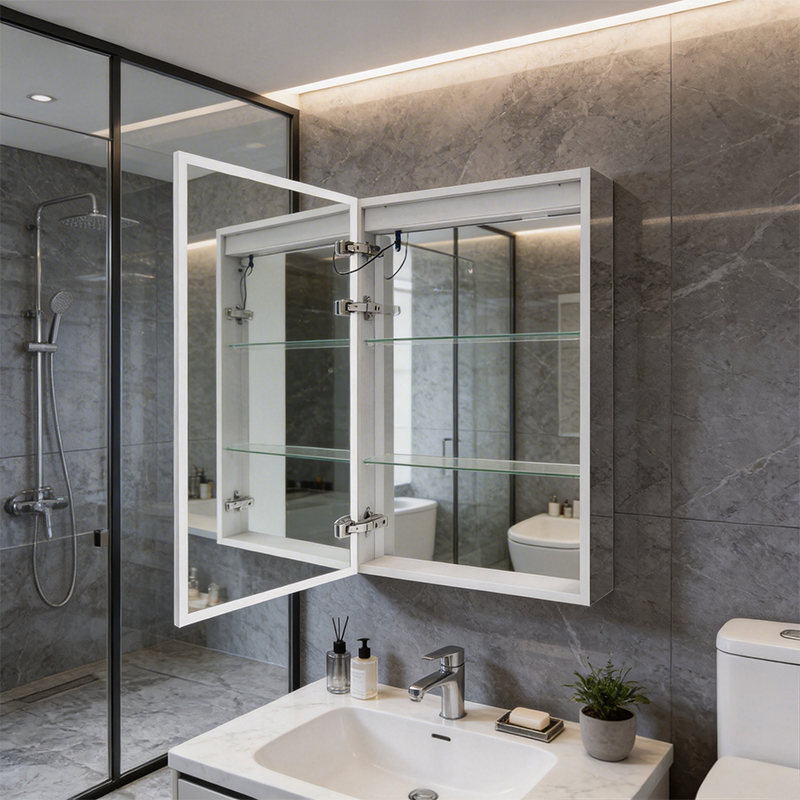
The mirror is naturally one of the most important parts of an LED mirror cabinet.
A good bathroom mirror should provide a clear and accurate reflection without obvious distortion. More importantly, it should be suitable for a humid bathroom environment.
Bathrooms regularly experience steam, moisture, and temperature changes. Over time, poor-quality mirrors may develop dark or black edges as the reflective coating deteriorates.
For this reason, buyers should pay attention not only to the thickness of the glass but also to the mirror coating and edge processing.
When evaluating samples, check:
Whether the reflection is clear from different viewing angles
Whether the mirror surface has scratches, bubbles, or visible defects
Whether the edges are properly polished
Whether the mirror is designed for long-term bathroom use
For commercial projects, consistent mirror quality across an entire production batch is just as important as the quality of one sample.
2. Look Beyond LED Brightness
A brighter mirror is not automatically a better mirror.
The purpose of lighting around a bathroom mirror is to provide comfortable and useful illumination for everyday activities such as washing, shaving, skincare, and applying makeup.
A high-quality LED Light Mirror Cabinet should therefore provide balanced illumination rather than simply using the highest possible lumen output.
Several lighting specifications deserve attention.
Color Temperature
Different color temperatures create different bathroom environments.
Warm white light can create a softer atmosphere, while neutral or cooler white light may provide a clearer appearance for grooming tasks.
Many modern mirror cabinets offer multiple color temperatures, allowing users to switch between different lighting conditions.
Color Rendering
Color Rendering Index (CRI) describes how accurately a light source reveals colors compared with natural light.
For bathroom mirrors, good color rendering is particularly useful because users often need to see skin tones, cosmetics, hair, and clothing accurately.
A CRI of 90 or above is commonly preferred for higher-quality mirror lighting.
Dimming
Dimming allows users to adjust brightness according to the time of day and their personal preferences.
Rather than offering only ON and OFF settings, a well-designed mirror cabinet may provide smooth brightness adjustment for a more comfortable user experience.
3. Pay Attention to How the Light Is Distributed
Two mirror cabinets can use similar LEDs but produce very different lighting results.
Why?
Because LED placement, diffuser design, mirror frosting, and the distance between the light source and the mirror all influence the final effect.
Poor LED design may create visible bright spots or uneven sections around the mirror.
A better design distributes light more evenly across the illuminated area.
When inspecting a sample, turn on the mirror in a relatively dark room and look carefully at the entire illuminated section. The brightness should appear consistent without obvious dark areas or individual LED points.
This simple test can reveal a lot about the lighting design.
4. Check the Anti-Fog Function
Anyone who has taken a hot shower knows how quickly a bathroom mirror can become covered in condensation.
An anti-fog or demister function is therefore more than an additional specification. It can significantly improve everyday usability.
An LED Light Mirror Cabinet with a properly designed demister pad heats a selected area behind the mirror, helping reduce condensation on that part of the glass.
However, buyers should not assume that every anti-fog system performs equally.
Check the size and position of the demister pad. A very small heating area may technically allow a supplier to advertise an "anti-fog" function while providing limited practical benefit.
For OEM projects, the size and placement of the demister area can also be discussed according to the mirror dimensions and target market.
5. Cabinet Material Matters
The cabinet operates in one of the most moisture-prone rooms in a building.
Material selection is therefore critical.
Aluminum is widely used for modern bathroom mirror cabinets because it is lightweight, corrosion resistant, and suitable for clean, contemporary designs.
Depending on the product positioning, other materials may also be used. Regardless of the material, buyers should evaluate how well the cabinet can handle long-term exposure to bathroom humidity.
Pay attention to:
Surface finishing
Corrosion resistance
Panel thickness
Structural stability
Corner finishing
Internal shelf support
Overall assembly quality
Open the cabinet and inspect areas that are less visible. Manufacturing quality is often easier to judge from the inside than from the polished exterior.
6. Don't Ignore Hinges and Door Hardware
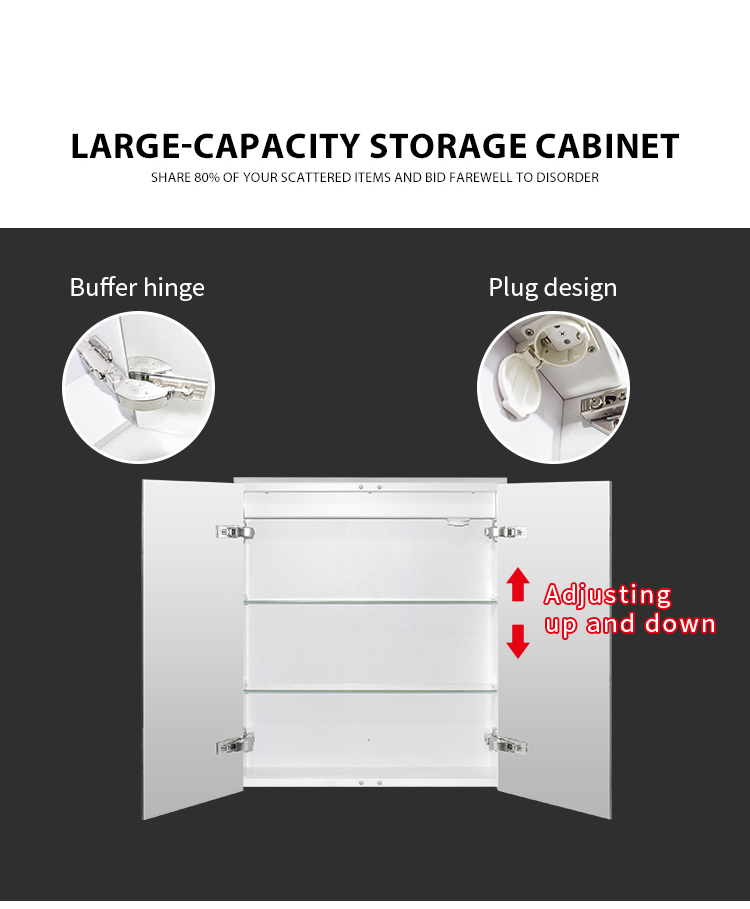
Hinges may seem like a small component, but they are used every time someone opens the cabinet.
Imagine a hotel room where the mirror cabinet door is opened several times per day. Over years of operation, this can represent thousands of opening and closing cycles.
Low-quality hinges may gradually become loose, noisy, or difficult to align.
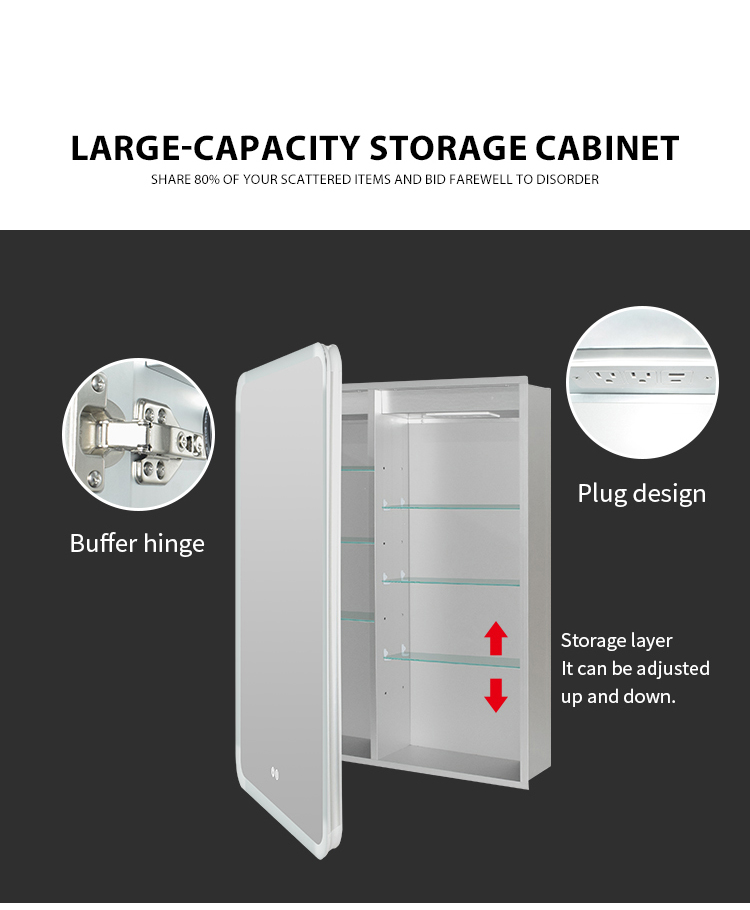
Quality hinges should provide smooth movement and hold the door securely in position. Soft-close hinges can also improve the user experience by preventing the mirrored door from closing too quickly.
For project buyers, it is worth asking suppliers whether the hinge system has undergone opening-and-closing cycle testing.
7. Examine the Storage Design
A good mirror cabinet should not sacrifice storage functionality simply to accommodate lighting and electronics.
The internal layout should make efficient use of the available space.
Consider questions such as:
Can the shelves be adjusted?
Is there enough room for taller bottles?
Are the shelves easy to remove and clean?
Can electrical components be accessed without interfering with storage?
Some projects may also require internal sockets, USB charging ports, magnifying mirrors, internal lighting, or other functions.
The best configuration depends on the target customer and intended application.
8. Electrical Safety Should Be a Priority
Bathroom electrical products operate in an environment where electricity and moisture are naturally close together.
Electrical safety should therefore be considered from the beginning of product development rather than added as an afterthought.
Buyers should evaluate the quality of components such as:
LED drivers
Wiring
Connectors
Touch switches
Power supplies
Insulation
Internal electrical connections
The appropriate certification and electrical requirements will vary depending on the destination market.
For B2B buyers importing mirror cabinets, it is important to tell the manufacturer where the products will be sold. Voltage, plugs, electrical components, labeling, and certification requirements may differ between North America, Europe, Australia, and other markets.
9. Smart Features Should Be Practical
Modern LED mirror cabinets can include an impressive range of functions.
Touch controls, adjustable color temperature, dimming, anti-fog systems, digital clocks, Bluetooth, USB charging, internal sockets, and motion sensors are all possible.
But more features do not automatically mean a better product.
The key question is:
Does the feature make the product more useful for the target customer?
For example, a hotel project may prioritize reliable lighting, anti-fog performance, simple controls, and durability. A premium residential product may place greater emphasis on adjustable lighting and smart functions.
Good product development is about selecting the right features rather than adding every available feature.
10. Manufacturing Quality Determines Consistency
This is particularly important for wholesale and project orders.
A buyer may receive an excellent sample, but what happens when the order increases to 500, 1,000, or several thousand units?
A reliable manufacturer needs a repeatable quality-control process.
Typical inspections may include checks on:
Mirror appearance
Cabinet dimensions
Door alignment
LED operation
Color temperature
Dimming
Touch controls
Anti-fog function
Electrical connections
Surface finishing
Packaging
Functional testing before packing is especially important for LED mirror cabinets because several electrical and mechanical systems are integrated into one product.
Consistency across mass production is one of the clearest differences between simply making a mirror cabinet and manufacturing one professionally.
What Should B2B Buyers Ask Before Ordering?
If you are sourcing an LED Light Mirror Cabinet for distribution, retail, hospitality, or a residential project, do not make your decision based only on appearance and price.
Before placing a large order, ask the manufacturer:
What mirror material is being used?
Understand the glass and coating specification.
What is the CRI and color temperature of the LEDs?
Lighting specifications should be clearly defined.
Can the lighting be customized?
Ask about brightness, CCT, dimming, and control options.
What cabinet material is used?
Consider durability and corrosion resistance.
Which electrical components are installed?
Drivers and other components can affect long-term reliability.
Which certifications are available?
Requirements should match your destination market.
Can you provide a production sample?
A physical sample allows you to evaluate details that specifications and photos cannot fully show.
What quality-control tests are performed?
This becomes increasingly important as order quantities increase.
Choosing the Right LED Light Mirror Cabinet Manufacturer
A good supplier should do more than provide a catalog.
For wholesalers, brands, contractors, and project buyers, the manufacturer should be able to understand technical requirements and translate them into a product that can be manufactured consistently.
Customization may involve cabinet dimensions, mirror shapes, LED specifications, color temperature, touch controls, demister systems, internal shelves, sockets, logos, and packaging.
At LANDLIGHTING, we focus on the development and manufacturing of lighting and mirror products for international markets. Our mirror range includes LED bathroom mirrors, makeup mirrors, mirror cabinets, and other customized mirror solutions.
For OEM and ODM projects, specifications can be discussed according to the application, target market, order quantity, and required functions.

Final Thoughts
A high-quality LED Light Mirror Cabinet is not defined by one feature.
It is the result of many details working together: a clear and durable mirror, comfortable LED lighting, reliable electrical components, moisture-resistant cabinet construction, practical storage, quality hinges, useful functions, and consistent manufacturing.
For homeowners, these details influence everyday convenience.
For hotels and residential projects, they affect long-term maintenance and user experience.
And for wholesalers and distributors, they can directly influence product returns, customer satisfaction, and brand reputation.
That is why evaluating an LED mirror cabinet should go beyond asking, "How much does it cost?"
A better question is:
How well is it designed, manufactured, and tested for long-term use?
